
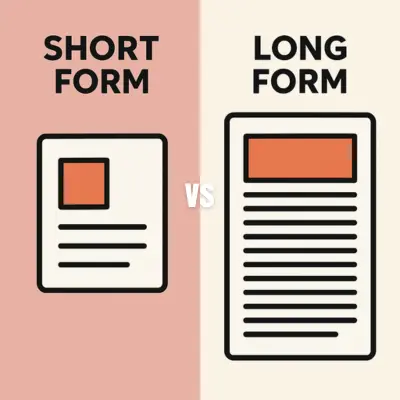
Short-Form vs. Long-Form Content. Where Should You Invest?
The answer isn’t “either/or”. It’s “what’s your goal?”
This is one of the most common questions I see right now:
“Should I focus on short-form content, or long-form content?”
It’s a fair question. Platforms push short-form hard.
At the same time, long-form content is quietly doing the heavy lifting behind the scenes.
The mistake most people make is choosing one based on trends, not strategy.
So let’s break this down properly.
What Short-Form Content Is Actually Good For
Short-form content is built for speed and reach.
Think:
- Instagram Reels
- TikToks
- YouTube Shorts
- LinkedIn short posts
Its job is to:
- grab attention
- introduce ideas
- spark curiosity
- bring people into your world
Short-form content is your top-of-funnel activity.
It helps people discover you.
But here’s the part that often gets missed. Attention without depth doesn’t build trust.
The Limitation of Short-Form
Short-form content rarely converts on its own.
You can get views.
You can get likes.
You can even get followers.
But followers don’t automatically become customers.
Why?
Because short-form doesn’t give you enough space to:
- explain properly
- show depth
- build authority
- answer objections
- guide decisions
That’s where long-form comes in.
What Long-Form Content Is Actually Good For
Long-form content is built for trust and authority.
Think:
- blog posts
- newsletters
- in-depth LinkedIn posts
- YouTube videos
- guides and PDFs
Its job is to:
- educate
- build credibility
- answer real questions
- demonstrate experience
- support decision-making
Long-form content is where people decide if you’re worth listening to.
This is the content that gets bookmarked, saved and revisited.
Why Long-Form Content Wins
With AI, search and answer engines changing fast, depth matters more than ever.
Long-form content helps you:
- rank in search
- appear in AI summaries
- build topical authority
- support email funnels
- create reusable assets
One strong blog post can become:
- multiple short-form clips
- newsletter sections
- carousel posts
- email sequences
Short-form disappears quickly.
Long-form compounds.
So… Where Should You Invest?
Here’s the honest answer:
If you’re early in your journey, or building alongside a full-time job, you need both, but not equally.
A smart approach looks like this:
- long-form for depth, trust and structure
- short-form for reach and visibility
Use long-form as the anchor.
Use short-form as the distribution.
This way, you’re not constantly chasing the algorithm, you’re building assets.
A Simple Content Strategy That Actually Works
Here’s a realistic setup
1 long-form blog or article per week
↓
Break it into:
- 3–5 short-form videos
- 2–3 carousel posts
- email content
- LinkedIn posts
This keeps you consistent without burning out.
Why This Matters for Career Professionals
If you’re a career professional building a digital presence, time is your biggest constraint.
You don’t need to post everywhere, every day.
You need a system that respects your schedule and compounds your effort.
Long-form gives you clarity.
Short-form gives you visibility.
Together, they create momentum.
Final Thoughts
Short-form content gets you seen.
Long-form content gets you trusted.
If you’re choosing one over the other, you’re asking the wrong question.
The real question is:
“How do I use both in a way that supports my goals?”
Build depth first.
Distribute second.
Repeat consistently.
If you want a clear, realistic content system that fits around your life, start with the Pivot-to-Pro Starter Bundle.
It gives you structure without overwhelming you and it helps you build content that actually leads somewhere.